Voltage Tester Screwdriver (Line Tester)
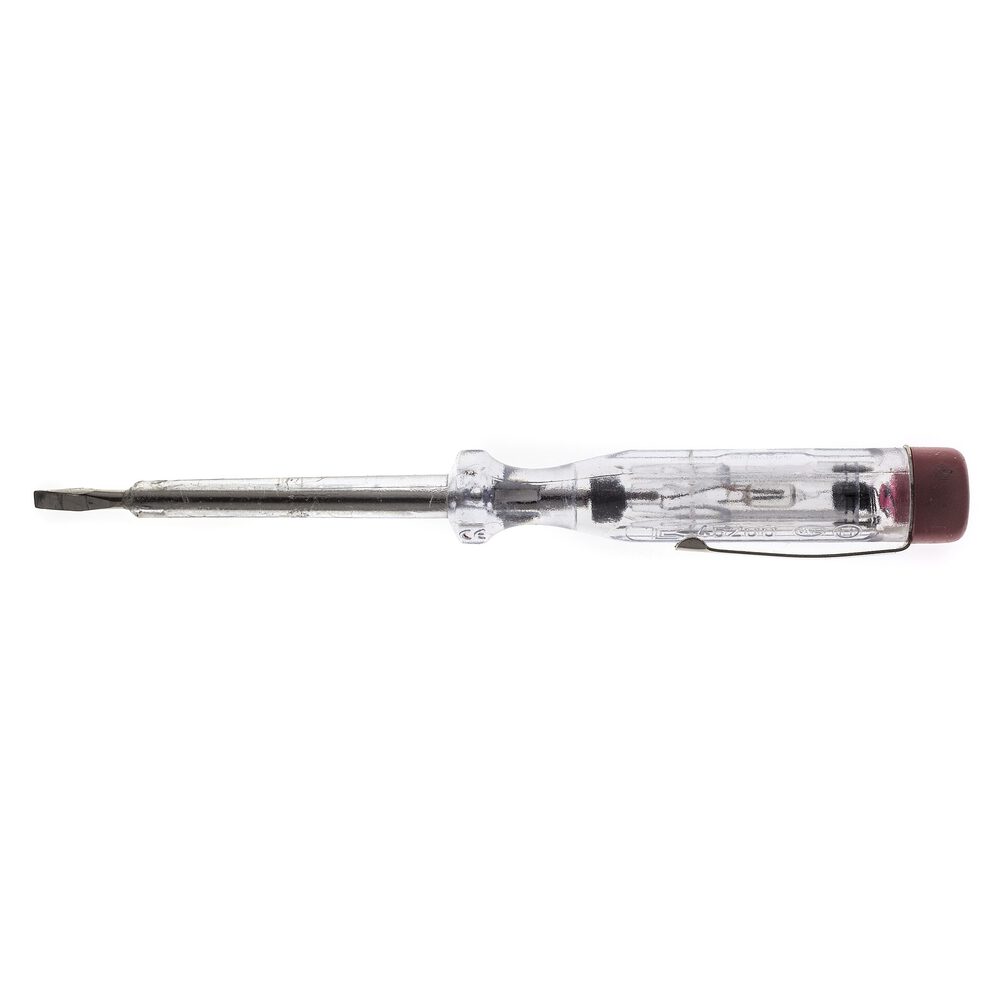
Neon voltage tester screwdriver (line tester) with a clear insulated handle and pocket clip for finding the live wire in sockets, switches and holders on 220–240 V AC home wiring.
| Option | Price | Availability | SKU |
|---|---|---|---|
| 140 mm | ৳80 | In stock | FSB-WA-TESTER-SD-140-MM |
| 190 mm | ৳130 | In stock | FSB-WA-TESTER-SD-190-MM |
Delivery across Bangladesh. Cash on delivery available.
Delivery:
- Inside Dhaka: ৳60, about 2 days
- Outside Dhaka: ৳120, about 5 days
Payment methods: Cash on delivery, bKash, Credit / debit card, Cards, mobile banking and internet banking (SSLCommerz)
Specifications
- Product code
- FSB-WA-TESTER-SD
- Type
- Voltage tester
- Type
- Single-pole neon voltage tester screwdriver
- Indication
- Neon lamp glows on a live AC conductor
- Typical working range
- Approximately 100–500 V AC (check the marking on the handle)
- Detects DC
- No
- Battery
- None required
- Blade
- Slotted steel tip, approximately 3 mm wide, with insulating sleeve on the shaft
- Handle
- Transparent insulated plastic with end contact cap and metal pocket clip
- Overall length
- 140 mm or 190 mm
- Application
- Electrical, Home
- Size
- 190 mm, 140 mm
Description
A voltage tester screwdriver — known in Bangladesh simply as a "tester" or line tester — is a small slotted screwdriver with a neon lamp inside its transparent handle. When the tip touches a live (phase) conductor and your finger touches the contact at the end of the handle, the lamp glows, showing that mains voltage is present. Electricians and householders use it to find which wire or socket hole is live before working on a switch, socket or light fitting.
How does a line tester work?
Inside the handle, a high-value resistor and a small neon lamp are connected in series between the blade and the contact at the end of the handle. When the blade touches a live conductor, a tiny, harmless current passes through the resistor and lamp and returns to earth through your body, which is enough to make the neon glow. That is why you must touch the end contact for the tester to work, and why it lights on the phase wire but not on the neutral.
How do you use it?
- Hold the tester by the insulated handle and rest one finger on the end contact (the cap and its metal clip). Do not touch the blade.
- Touch the tip to the terminal, wire end or socket hole you want to check.
- A glowing lamp means the point is live. No glow means no voltage was detected — but see the limits below.
- Test the tester on a known live point first, and again afterwards, to be sure it is working.
What can and cannot it tell you?
| It can | It cannot |
|---|---|
| Show which conductor is the live (phase) | Measure how many volts are present |
| Help find a dead socket or a blown fuse | Prove a circuit is completely safe to touch |
| Check the phase side of a switch or holder | Detect DC or very low voltages |
| Work reliably in bright sunlight, where the faint glow is hard to see |
For proving a circuit dead before work, electricians use a two-pole voltage tester or multimeter and switch off the breaker. Treat a line tester as a quick indicator, not a guarantee.
Which size should you choose?
- 140 mm — pocket size with clip, for household sockets, switches and holders.
- 190 mm — longer blade for reaching terminals inside distribution boards and deep fittings.
The usual working range printed on the handle is about 100–500 V AC; Bangladesh household supply is 220–240 V, 50 Hz.
Applications
- Finding the live wire in sockets, switches and lamp holders
- Household and office electrical repairs
- Checking fuses and distribution board terminals
- Electricians, technicians and maintenance staff tool kits
- Electrical trade training
Recommended usage
Hold by the insulated handle with one finger on the end contact, touch the tip to the point being checked and look for the neon glow, shading the handle with your hand in bright light. Prove the tester on a known live point before and after every check.
Safety instructions
Use only on low-voltage AC within the range marked on the handle; never on high-voltage lines or equipment. Never touch the blade while testing. No glow does not prove a circuit is dead — switch off the breaker and confirm with a proper two-pole tester before work. Do not use if the handle is cracked, wet or the lamp is damaged, and do not use it as a pry bar or for heavy screwdriving.
Frequently asked questions
How does a tester screwdriver work?
A tester screwdriver lights a small neon lamp when its tip touches a live wire and your finger touches the contact at the end of the handle. A resistor inside limits the current to a tiny, harmless level that flows through the lamp and your body to earth, which is enough to make the neon glow.
Why does the tester light on one wire but not the other?
The tester lights only on the live (phase) wire because that is the conductor at mains voltage relative to earth. The neutral wire is close to earth potential, so almost no current flows through the lamp and it stays dark. If it glows on both, or on neither, the wiring needs checking by an electrician.
Is it safe to rely on a line tester before touching a wire?
No, a line tester alone is not enough to prove a wire is safe to touch. It can fail to glow because of a weak lamp, bright light, dry insulated footwear or a poor contact. Switch off the breaker, confirm with a two-pole tester or multimeter, and only then work on the circuit.
Can a tester screwdriver be used as a normal screwdriver?
Only for light work such as loosening small terminal screws. The handle is hollow to hold the lamp and resistor, so heavy turning or prying can crack it and make the tester unsafe. Use a proper insulated screwdriver for tight screws.