Non-Contact Voltage Tester Pen
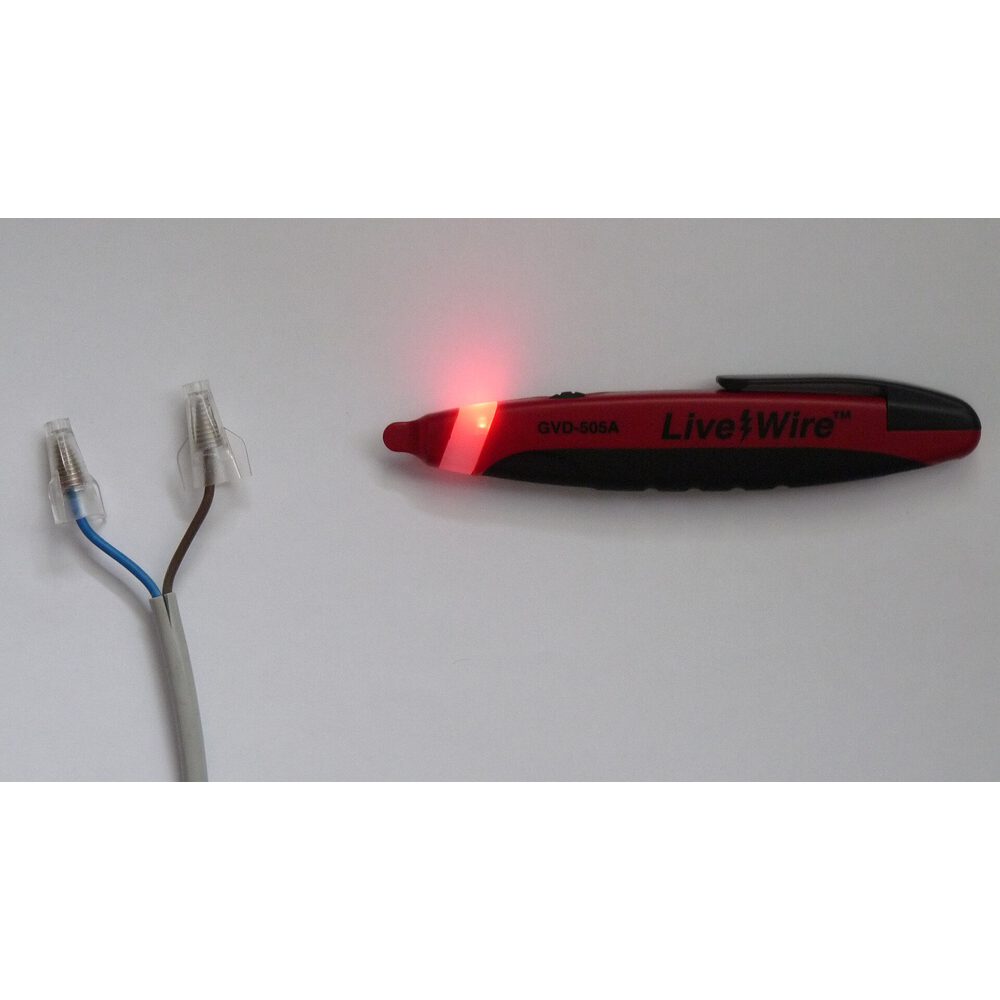
Pen-type non-contact AC voltage tester with a red LED tip that lights near a live wire, socket or cable without touching bare metal. Battery powered, pocket clip, for 220–240 V wiring.
| Option | Price | Availability | SKU |
|---|---|---|---|
| Pen tester with batteries | ৳650 | In stock | FSB-WA-TESTER-NCV-PEN-TESTER-WITH-BATTERIES |
Delivery across Bangladesh. Cash on delivery available.
Delivery:
- Inside Dhaka: ৳60, about 2 days
- Outside Dhaka: ৳120, about 5 days
Payment methods: Cash on delivery, bKash, Credit / debit card, Cards, mobile banking and internet banking (SSLCommerz)
Specifications
- Product code
- FSB-WA-TESTER-NCV
- Type
- Voltage tester
- Type
- Pen-type non-contact AC voltage detector
- Indication
- Red LED at the tip
- Typical detection range
- Approximately 90–1000 V AC (check the marking on the body)
- Frequency
- 50/60 Hz
- Detects DC
- No
- Batteries
- 2 × AAA (typical)
- Body
- Red and black insulated plastic with pocket clip
- Length
- Approximately 150 mm
- Color
- Red
- Application
- Electrical, Industrial, Home
Description
A non-contact voltage tester is a pen-shaped electronic detector that tells you whether a wire, socket, switch or cable is carrying AC voltage without touching any bare conductor. Hold the tip close to the insulation: if voltage is present, the tip lights red. It is the quick first check electricians, technicians and careful householders make before opening a fitting.
How does a non-contact tester work?
A live AC conductor is surrounded by a changing electric field. A sensor in the tip of the pen picks up that field through the insulation by capacitive coupling, and a small battery-powered circuit switches on the LED (and, on many models, a beeper). Because it senses the field rather than the current, it works even when no appliance is running — and it works only on AC, not on DC such as batteries or solar panels.
Where is it useful?
- Checking whether a socket, switch or lamp holder is live before removing the cover
- Finding which cable in a bundle or trunking is energised
- Tracing a break in an extension lead — the light stops where the live core is broken
- Confirming that a breaker has actually cut the supply to a circuit
- Routine checks by facility, IT and maintenance staff who are not electricians
Non-contact tester or tester screwdriver?
| Non-contact pen | Neon tester screwdriver | |
|---|---|---|
| Needs bare metal contact | No — works through insulation | Yes |
| Power | Batteries | None |
| Indication | Bright LED, often with sound | Faint neon glow |
| Typical use | Fast scanning of cables and sockets | Identifying the phase terminal |
Many electricians carry both.
What are its limits?
A non-contact tester is an indicator, not a measuring instrument. It may not respond to shielded or armoured cable, wires inside metal conduit or behind earthed metal covers, conductors deep inside a thick cable, or DC. It can also light near a wire that is only carrying induced "ghost" voltage. Always prove it on a known live source before and after use, and confirm a circuit is dead with a two-pole tester or multimeter before touching conductors.
What should you look for when buying?
Check the AC voltage range printed on the body — general-purpose pens commonly cover roughly 90–1000 V AC, which suits Bangladesh's 220–240 V supply — and look for a measurement category marking such as CAT III or CAT IV, which indicates the kind of installation the tool is designed for. Replace the batteries as soon as the indicator weakens.
Applications
- Checking sockets, switches and light fittings before opening them
- Identifying live cables in trunking, ducts and distribution boards
- Tracing breaks in extension leads and appliance cords
- Facility, IT and factory maintenance rounds
- Electricians and technicians tool kits
Recommended usage
Test the pen on a known live socket first, then hold the tip against the insulation of the cable, socket slot or switch being checked and watch for the red light. Test it again on the known live source afterwards to confirm it was working throughout.
Safety instructions
No light does not mean no voltage: shielded cable, metal conduit, weak batteries or DC can all give a false "safe" result. Always confirm a circuit is dead with a two-pole tester or multimeter before touching conductors. Use only within the voltage range and category marked on the body, keep fingers behind the grip, and do not use if the casing is cracked or wet.
Frequently asked questions
How does a non-contact voltage tester work?
A non-contact voltage tester senses the electric field around a live AC conductor. A sensor in the tip picks up the field through the insulation by capacitive coupling and a battery-powered circuit lights the LED, so you do not need to touch bare metal.
Can a non-contact tester detect DC voltage?
No, a non-contact tester detects AC voltage only. DC sources such as batteries, solar panels, IPS battery banks and vehicle wiring do not create the changing electric field it needs, so use a multimeter for DC.
Is a non-contact voltage tester reliable?
It is reliable as a quick indicator but not as final proof that a circuit is dead. It can miss voltage in shielded cable or metal conduit and can light on harmless induced voltage. Prove it on a known live source before and after use, and confirm with a two-pole tester or multimeter before touching wires.
What does CAT III or CAT IV mean on a voltage tester?
CAT III and CAT IV are measurement categories that describe where in an electrical installation a tester is designed to be used. CAT III covers fixed wiring such as distribution boards and socket circuits inside a building; CAT IV covers the supply side, such as the service entrance and meter. The number beside it is the maximum voltage for that category.