Water Filled Plastic Road Barrier
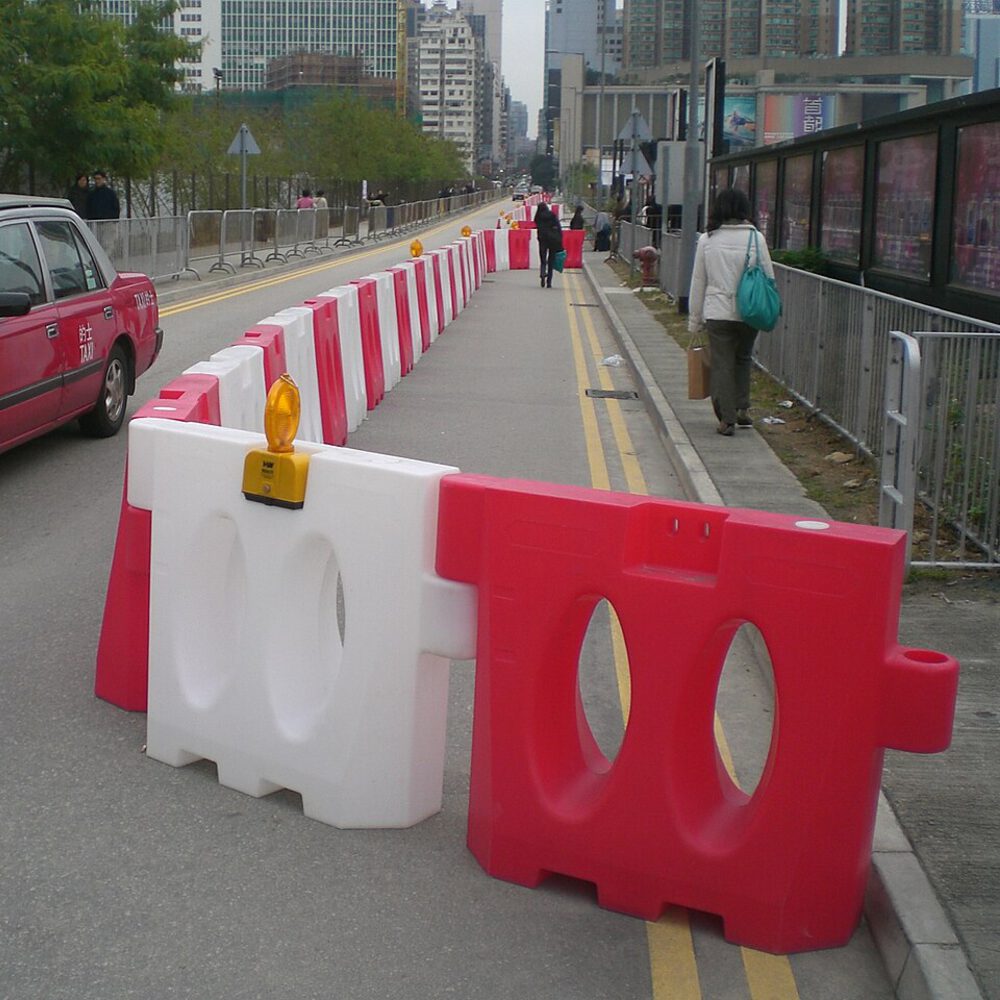
Hollow plastic road barrier in red or white that is filled with water or sand for weight and interlocks into a continuous line. For road works, diversions, sites and events.
| Option | Price | Availability | SKU |
|---|---|---|---|
| White | ৳5,500 | In stock | FSB-WS-WFB-WHITE |
| Red | ৳5,500 | In stock | FSB-WS-WFB-RED |
Delivery across Bangladesh. Cash on delivery available.
Delivery:
- Inside Dhaka: ৳60, about 2 days
- Outside Dhaka: ৳120, about 5 days
Payment methods: Cash on delivery, bKash, Credit / debit card, Cards, mobile banking and internet banking (SSLCommerz)
Specifications
- Product code
- FSB-WS-WFB
- Type
- Road barrier
- Type
- Water / sand filled plastic road barrier
- Colours
- Red, white
- Material
- Moulded polyethylene (PE), hollow
- Length
- Approximately 1.3–1.5 m depending on model
- Height
- Approximately 0.8 m
- Connection
- Moulded pin-and-socket connector at each end
- Ballast
- Water or sand through top fill cap; drain plug near the base
- Handling
- Carried by hand when empty
- Color
- Red, White
- Application
- Road, Construction, Event
Description
A water filled road barrier is a hollow moulded plastic block that is carried to site empty and light, set in position, and then filled with water or sand so that it is too heavy to be pushed aside. Each unit has a pin-and-socket connector at its ends, so the barriers link into a continuous wall. These barriers are supplied in red and in white and are normally placed alternately, giving the red-white line that drivers recognise as road works.
What is it used for?
- Separating traffic from road, flyover, drain and utility works
- Lane diversions, U-turn closures and temporary road dividers
- Fencing the boundary of a construction site or a delivery gate
- Guiding pedestrians along a temporary footway beside traffic
- Channelling vehicles and crowds at events, toll and parking areas
Why choose a water filled barrier?
| Water filled plastic barrier | Concrete barrier | Cones and tape | |
|---|---|---|---|
| Moving and placing | By hand when empty | Needs a crane or forklift | By hand |
| Stays in place | Yes, once filled | Yes | No |
| Continuous line | Yes, units interlock | Yes | No |
| Visibility | Bright red and white | Grey unless painted | Good, but gaps between cones |
How do you install it?
- Place the empty barriers in a line and join each one to the next with the moulded connector.
- Open the fill cap on top and fill with water. Sand can be used instead where the barrier will stay for a long time.
- Put warning lights or reflectors on the line for night use.
- To move the barriers, open the drain plug near the bottom, let the water out and carry them empty.
How many do you need?
Divide the length you want to close by the length of one unit (approximately 1.3–1.5 m depending on the model), and add a few for corners and gates.
What this barrier is not
A plastic water filled barrier of this kind marks and separates; it is not a crash barrier and should not be relied on to stop a vehicle travelling at speed. Where workers need protection from fast traffic, use a barrier system that has been crash-tested for that purpose.
Applications
- Road, flyover and drain construction works
- Lane diversions and temporary road dividers
- Construction site boundaries and gates
- Temporary pedestrian walkways beside traffic
- Events, toll plazas and parking areas
- Factory and port internal roads
Recommended usage
Place the barriers empty, connect them into a line and then fill them with water or sand. Alternate red and white units for the best visibility, and add warning lights or reflectors for night use. Drain the water before moving them.
Safety instructions
This is a delineation barrier, not a vehicle crash barrier — do not rely on it to stop a moving vehicle. An empty barrier can be blown or pushed out of line, so fill it as soon as it is in position. Do not leave stagnant water open: keep the fill cap closed and drain or refresh the water regularly so that it does not breed mosquitoes.
Frequently asked questions
What is a water filled barrier?
It is a hollow plastic road barrier that is light enough to carry when empty and is filled with water or sand on site to make it heavy and stable. The units lock together end to end, forming a continuous red and white line around road works or a site.
Should I fill the barrier with water or sand?
Water is the usual choice because it is quick to fill and easy to drain when the barrier has to be moved. Sand makes the barrier heavier and does not leak or evaporate, so it suits long-term positions, but it is much harder to empty.
Can a water filled plastic barrier stop a car?
No, not reliably. A light plastic barrier of this type is meant to mark and separate traffic at low speed; it can be pushed or broken by a vehicle. To protect workers from fast traffic you need a crash-tested barrier system or concrete barriers.
How are the barriers joined together?
Each barrier has a moulded connector at its ends — a pin or lug on one end that drops into a socket on the next unit. Joined this way the line can follow gentle curves and corners and cannot be opened without lifting a unit.
Will the plastic barrier fade or crack in the sun?
All coloured plastics fade gradually in strong sunlight, and after some years outdoors the plastic also becomes more brittle. Barriers kept filled and handled carefully last longer; replace any unit that has cracked and no longer holds water.