Reflective Warning Triangle for Car (Folding)
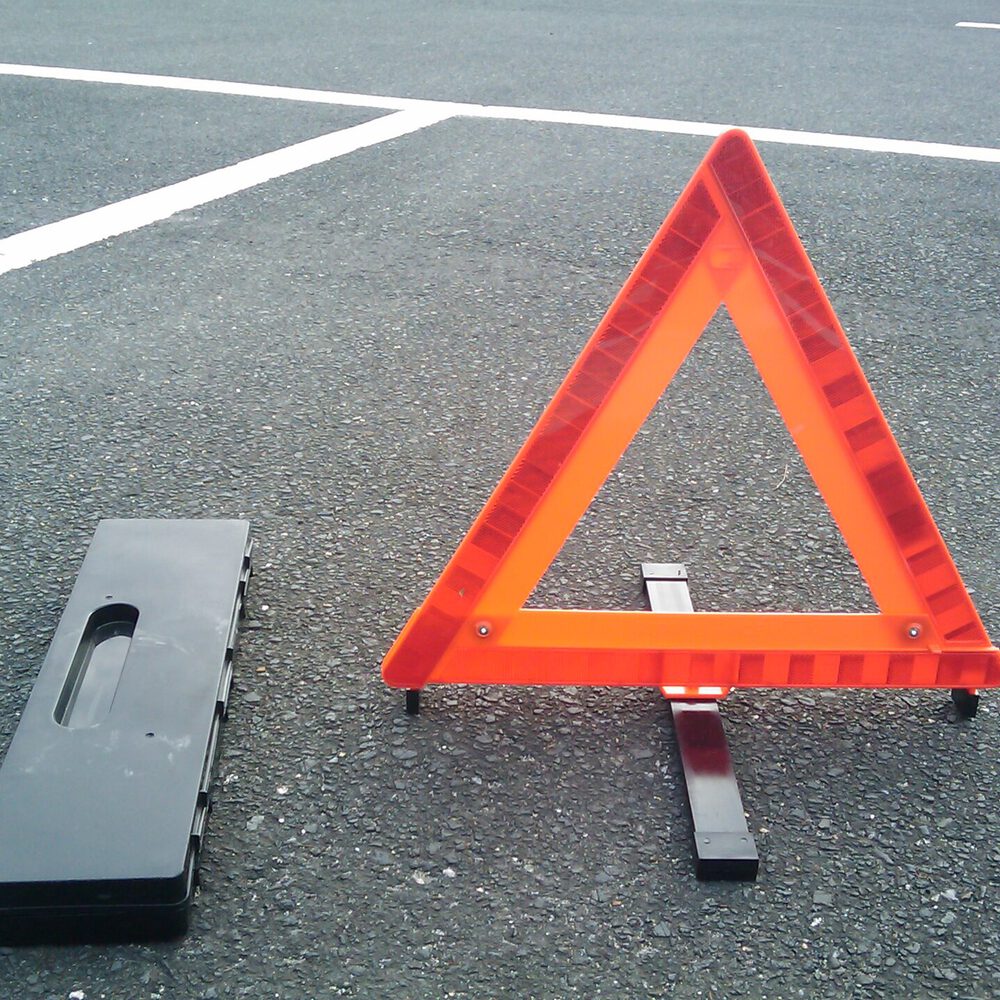
Folding red reflective warning triangle with stable metal stand and black storage case. Placed behind a broken-down car, truck or bus to warn approaching traffic, day and night.
| Option | Price | Availability | SKU |
|---|---|---|---|
| 1 piece with case | ৳550 | In stock | OVY-HV-TRI-1-PIECE-WITH-CASE |
| Pack of 2 with cases | ৳1,000 | In stock | OVY-HV-TRI-PACK-OF-2-WITH-CASES |
Delivery across Bangladesh. Cash on delivery available.
Delivery:
- Inside Dhaka: ৳60, about 2 days
- Outside Dhaka: ৳120, about 5 days
Payment methods: Cash on delivery, bKash, Credit / debit card, Cards, mobile banking and internet banking (SSLCommerz)
Specifications
- Product code
- OVY-HV-TRI
- Type
- Vehicle warning device
- Type
- Folding emergency warning triangle
- Colour
- Red retro-reflective bars with fluorescent orange-red inner edge
- Shape
- Equilateral triangle, sides approximately 40–45 cm
- Reflector material
- Moulded plastic prismatic reflectors
- Stand
- Fold-out metal legs
- Storage
- Black rigid plastic case
- Visibility
- Reflective at night, fluorescent by day
- Application
- Car, Truck, Bus
- Color
- Red
- Pack Size
- 2 pieces, 1 piece
Description
A warning triangle is a folding red reflective triangle that is stood on the road behind a stopped vehicle so that approaching drivers see the hazard early and move over. It is one of the simplest pieces of safety equipment a vehicle can carry, and on unlit highways at night it is often the only thing that makes a stationary car or truck visible in time.
How does it work?
The triangle has two kinds of surface. The outer red bars are retro-reflectors that throw headlight beams straight back to the driver, so the triangle glows at night. The inner orange-red edge is fluorescent, which stands out in daylight, dusk and rain. Together they are recognisable from far away in all conditions.
How far behind the vehicle should you place it?
| Road | Distance behind the vehicle |
|---|---|
| City street | About 30–50 m |
| Two-lane highway | About 50–100 m |
| Fast highway or expressway | 100 m or more |
| Just after a bend or hill crest | Before the bend or crest, so drivers see it in time |
Place it in the same lane as your vehicle, near the edge, and walk facing the traffic with the triangle held in front of you so that it is visible while you carry it. Switch on the hazard lights as well.
How do you set it up?
- Take the triangle out of its case and unfold the three sides until the top corner clips together.
- Swing out the metal legs under the base to form a stand.
- Stand it upright facing the oncoming traffic.
- When you leave, collect it last.
What should you look for when buying?
- A wide, weighted stand that stays up in the wind of passing trucks
- Bright, unscratched reflectors on all three sides
- A rigid case so the reflectors are not scratched in the boot
- As buying advice: triangles made for the European market carry an ECE R27 "E" mark moulded into the plastic
Who should carry one?
Every car, microbus, pickup, bus and truck. Heavy vehicles and long trailers commonly carry two, so one can be placed in front of the vehicle on a two-way road.
Applications
- Breakdowns and punctures on highways
- Accident scenes before help arrives
- Cars, microbuses and pickups
- Buses, trucks, trailers and tank lorries
- Roadside repair and tyre-change stops
- Driving schools and fleet vehicles
Recommended usage
Keep the triangle in its case in the boot or cab where it can be reached without unloading. On a breakdown, switch on the hazard lights, then carry the opened triangle towards the traffic and stand it in your lane 50 to 100 m behind the vehicle — further on fast roads and before any bend.
Safety instructions
Watch the traffic at all times while placing and collecting the triangle; wear a reflective vest at night if you have one. Get passengers out of the vehicle and well off the road. A triangle does not replace hazard lights. Replace it if the reflectors are cracked, faded or badly scratched.
Frequently asked questions
How far behind a car should a warning triangle be placed?
Place it about 50 metres behind the vehicle on an ordinary road and 100 metres or more on a fast highway. If you have stopped just after a bend or the top of a hill, put it before the bend so drivers see it before they see your vehicle.
Is a warning triangle useful at night?
Yes, night is when it matters most. The red bars are retro-reflectors that send headlight beams straight back to the driver, so the triangle shines brightly from a long way off even when your own lights have failed.
How many warning triangles should a truck or bus carry?
Heavy vehicles commonly carry two. One goes behind the vehicle and the other in front, or further back, so that traffic from both directions is warned on a two-way road.
What is the difference between a warning triangle and hazard lights?
Hazard lights mark the vehicle itself, while a triangle warns drivers before they reach it. The triangle also keeps working when the battery is flat or the lights are damaged, so the two should be used together.