Jumper Cables for Car Battery (Booster Cables)
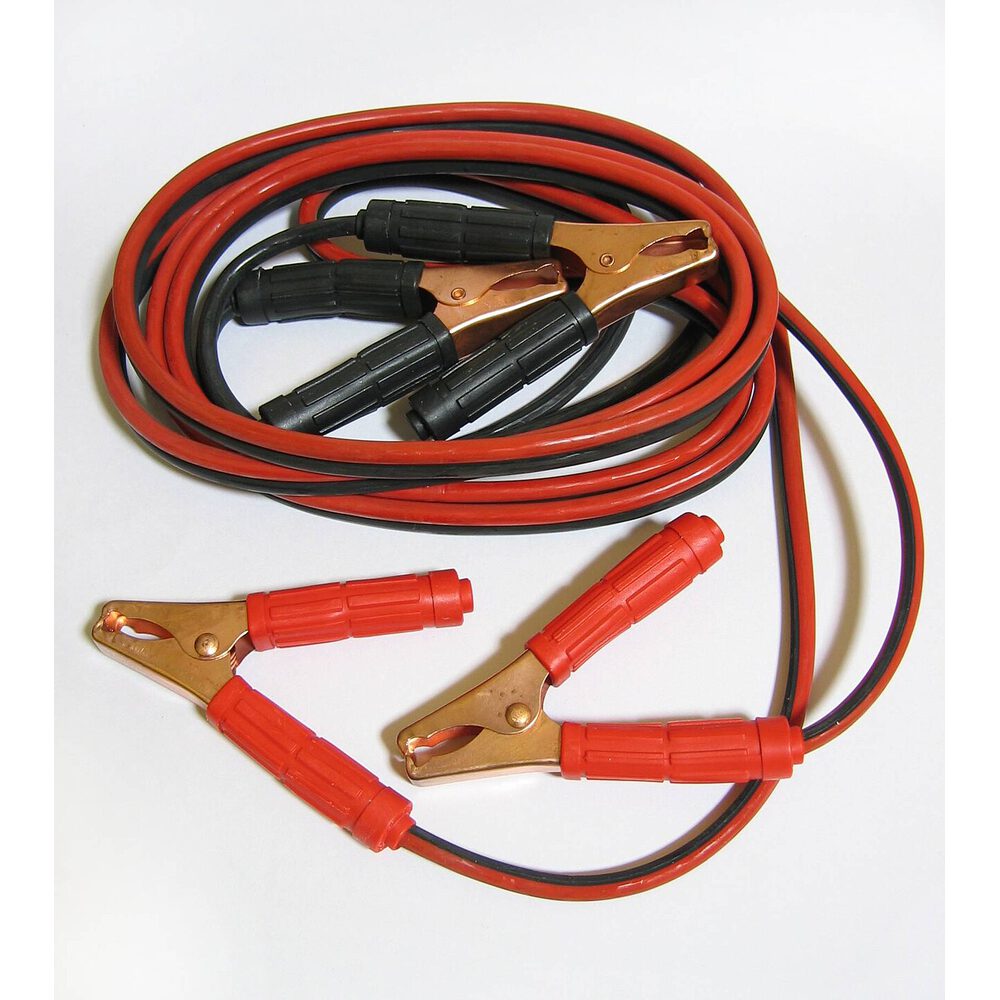
Red and black 12 V jumper (booster) cables with insulated crocodile clamps for starting a car with a flat battery from another vehicle. Light-duty and heavy-duty sets.
| Option | Price | Availability | SKU |
|---|---|---|---|
| Light duty, 3.5 m | ৳650 | In stock | FSB-HV-JUMP-LIGHT-DUTY-35-M |
| Heavy duty, 3 m | ৳1,400 | In stock | FSB-HV-JUMP-HEAVY-DUTY-3-M |
Delivery across Bangladesh. Cash on delivery available.
Delivery:
- Inside Dhaka: ৳60, about 2 days
- Outside Dhaka: ৳120, about 5 days
Payment methods: Cash on delivery, bKash, Credit / debit card, Cards, mobile banking and internet banking (SSLCommerz)
Specifications
- Product code
- FSB-HV-JUMP
- Type
- Vehicle emergency tool
- Use
- Jump-starting 12 V vehicle batteries
- Colour coding
- Red — positive (+); black — negative (−)
- Conductor
- Flexible multi-strand cable, PVC insulated
- Clamps
- Four spring crocodile clamps with copper-plated jaws
- Clamp insulation
- Full-length red and black plastic sleeves
- Lengths
- Approximately 3–3.5 m
- Not for
- 24 V truck and bus systems (light-duty set)
- Application
- Car, Microbus, SUV
- Color
- Red / Black
Description
Jumper cables — also called booster cables or jump leads — are a pair of thick insulated wires with a spring clamp at each end, used to start a vehicle whose battery has gone flat by borrowing power from another vehicle's battery. The red cable connects the positive terminals and the black cable the negative side.
When do you need them?
- Headlights or the cabin light were left on overnight
- The car has stood unused for weeks
- An old battery gives up on a cool morning or after a short trip
- The self-starter only clicks, or turns the engine very slowly
A set in the boot gets you moving in minutes instead of waiting for a mechanic or pushing the car.
How do you jump-start a car? (Correct order)
Park the two vehicles close but not touching, switch both off, and put them in neutral or park with the handbrakes on.
- Red clamp to the positive (+) terminal of the flat battery.
- Other red clamp to the positive (+) terminal of the good battery.
- Black clamp to the negative (−) terminal of the good battery.
- Last black clamp to bare, unpainted metal on the engine or chassis of the car with the flat battery — away from the battery itself.
- Start the helping car and let it run for two or three minutes.
- Start the car with the flat battery.
- Remove the clamps in the reverse order, without letting them touch each other.
Then drive for at least 20–30 minutes so the alternator can recharge the battery.
Which set should you choose?
| Set | Suits |
|---|---|
| Light duty, 3.5 m | Small and medium petrol cars, CNG auto-rickshaws |
| Heavy duty, 3 m | SUVs, microbuses, pickups and diesel engines |
Bigger engines draw more current when starting, so they need a thicker copper conductor; a thin cable simply heats up and the engine still will not turn. Longer cables are easier to use when the cars cannot be parked nose to nose.
What makes a good set?
Flexible multi-strand conductors, fully insulated clamp handles in red and black, strong springs and copper-plated jaws that bite on the terminal.
Applications
- Private cars, SUVs and microbuses
- Pickups and light commercial vehicles
- CNG auto-rickshaws
- Garages and car workshops
- Rental, ride-sharing and office fleets
- Generators with 12 V starter batteries
Recommended usage
Keep the cables coiled in their bag in the boot. Connect red to positive on both batteries first, then black to the good battery's negative and finally to bare metal on the stalled car. Run the helping engine a few minutes before starting, and disconnect in reverse order.
Safety instructions
Use only between vehicles of the same voltage (12 V to 12 V). Never let the red and black clamps touch once connected, and never connect the last black clamp to the flat battery's own negative post — a spark there can ignite battery gas. Do not jump-start a battery that is cracked, leaking or swollen. For hybrid and electric vehicles follow the owner's manual.
Frequently asked questions
In what order do you connect jumper cables?
Connect red to the flat battery's positive, red to the good battery's positive, black to the good battery's negative, and the last black clamp to bare metal on the car with the flat battery. Remove them in exactly the reverse order once the engine is running.
Why should the last black clamp not go on the dead battery?
The final connection usually makes a small spark, and a battery can give off flammable hydrogen gas. Clamping onto bare metal on the engine or chassis keeps that spark away from the battery.
Which jumper cable is right for my car?
A light-duty set is enough for small and medium petrol cars, while SUVs, microbuses and diesel engines need a heavy-duty set with thicker copper conductors. If in doubt choose the heavier set — it works on small cars too.
Can jumper cables damage a car?
Used correctly they do not, but connecting them the wrong way round can damage the electronics, blow fuses or harm the battery. Always match red to positive, check the + and − marks on both batteries, and keep the clamps from touching.