Emergency Eyewash Station (Wall Mounted)
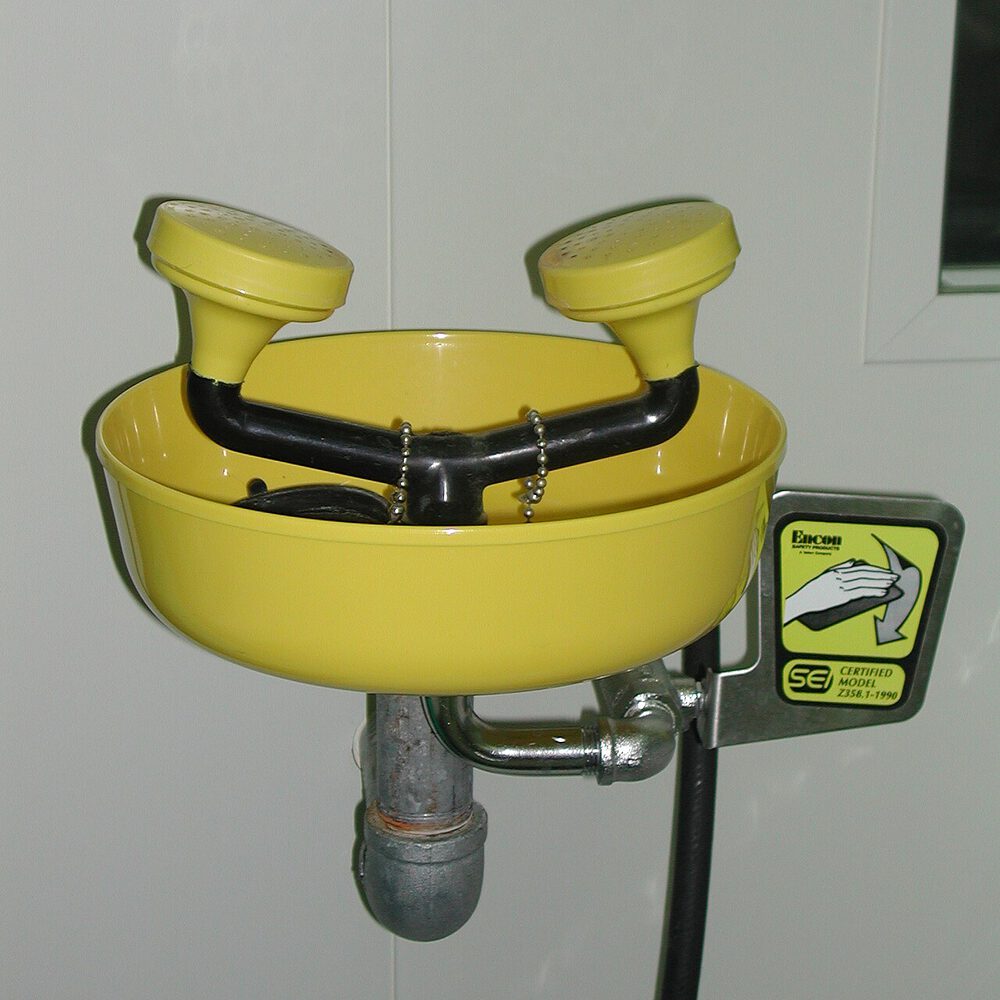
Wall mounted plumbed emergency eyewash station with yellow bowl, twin spray heads with dust covers and a push-paddle valve, for laboratories, chemical stores, dyeing and washing plants.
| Option | Price | Availability | SKU |
|---|---|---|---|
| Wall mounted eyewash | ৳22,500 | In stock | OVY-WA-EYEWASH-WALL-MOUNTED-EYEWASH |
Delivery across Bangladesh. Cash on delivery available.
Delivery:
- Inside Dhaka: ৳60, about 2 days
- Outside Dhaka: ৳120, about 5 days
Payment methods: Cash on delivery, bKash, Credit / debit card, Cards, mobile banking and internet banking (SSLCommerz)
Specifications
- Product code
- OVY-WA-EYEWASH
- Type
- Emergency eyewash
- Type
- Plumbed emergency eyewash, wall mounted
- Activation
- Hand push paddle, stay-open valve
- Bowl
- Yellow impact-resistant plastic, approximately 25–30 cm diameter
- Spray heads
- Two, with flip-off dust covers
- Mounting
- Wall bracket
- Water inlet
- Typically 1/2 inch threaded
- Waste outlet
- Typically 1-1/4 inch threaded
- Supply pressure
- Typically about 0.2–0.4 MPa (2–4 bar); test flow after installation
- Application
- Chemical, Industrial, Laboratory
- Color
- Yellow
- Model
- Wall mounted
Description
An emergency eyewash station is a fixed fountain that sends two gentle streams of water upward into both eyes at once, so that a person splashed with a chemical, dust or hot liquid can flush their eyes immediately and keep flushing with both hands free. This wall mounted model connects to the building water supply and has a high-visibility yellow bowl, twin spray heads with flip-off dust covers and a large push paddle that turns the water on in one movement.
Where do you need an eyewash station?
Wherever people handle substances that can injure the eyes:
- chemical stores, dyeing, washing and ETP areas of textile and garment factories;
- school, university, hospital and industrial laboratories;
- battery charging rooms, electroplating and pharmaceutical plants;
- tanneries, paint shops, and pesticide or fertiliser stores.
The first seconds matter most with a chemical splash, so the eyewash should be close to the hazard — widely used guidance (ANSI/ISEA Z358.1) is that it should be reachable within about 10 seconds along a clear, unobstructed path on the same level.
How do you use it?
- Push the paddle forward — the valve stays open by itself and the dust covers lift off with the water.
- Hold both eyelids open with your fingers and lower your face into the streams.
- Roll your eyes so that water reaches the whole surface.
- Keep flushing for at least 15 minutes, or as stated on the chemical's safety data sheet, and remove contact lenses while flushing if you can.
- Get medical attention afterwards and take the chemical label or data sheet with you.
What should you check before installing?
| Point | Guidance commonly followed |
|---|---|
| Location | Within about 10 seconds' reach of the hazard, well lit, marked with a sign |
| Nozzle height | About 84–135 cm above the floor |
| Water | Clean, drinkable-quality supply at lukewarm temperature (about 16–38 °C) |
| Flow | Both eyes flushed together, at least about 1.5 litres per minute for 15 minutes |
| Valve | Opens in one second or less and stays open hands-free |
| Drain | Connect the bowl waste to a drain so the floor does not flood |
Actual flow depends on your water pressure and pipe size, so test the unit after installation.
Maintenance
Run the eyewash briefly every week to flush stale water and sediment from the pipe and to prove it works, keep the dust covers on, and keep the area in front of it clear. A plumbed unit needs a reliable water line; where there is none, use a self-contained tank or sealed eyewash bottles instead.
Applications
- Chemical stores, dyeing, washing and ETP areas
- School, university, hospital and industrial laboratories
- Battery charging rooms and electroplating shops
- Pharmaceutical, paint and tannery plants
- Pesticide, fertiliser and cleaning chemical stores
Recommended usage
Install on a solid wall within about 10 seconds' reach of the chemical hazard, with the nozzles roughly 84–135 cm above the floor, connected to a clean water supply and a drain. Mark it with an eyewash sign, keep the approach clear, activate it weekly and train every worker in the area to use it.
Safety instructions
Use only clean, drinkable-quality water at a comfortable lukewarm temperature — very hot or very cold water can injure the eye. Never block the unit with drums, trolleys or boxes, and never shut off its supply valve. Flushing is first aid, not treatment: after any chemical splash, keep flushing for at least 15 minutes and then get medical attention.
Frequently asked questions
How long should you flush your eyes at an eyewash station?
Flush for at least 15 minutes after a chemical splash, holding the eyelids open the whole time. Some chemicals, such as strong alkalis, call for longer flushing — follow the safety data sheet — and you should see a doctor afterwards even if the eye feels better.
Where should an emergency eyewash station be installed?
Install it on the same level as the hazard and close enough to reach in about 10 seconds along a clear path. Choose a well-lit spot, mark it with a green eyewash sign, keep the nozzles about 84–135 cm above the floor and never store anything in front of it.
What is the difference between a plumbed eyewash and an eyewash bottle?
A plumbed eyewash is connected to the water line and can flush both eyes continuously for 15 minutes or more. An eyewash bottle holds only a small amount of fluid and lasts a minute or two, so it is a supplement for the first seconds or for places with no water line, not a replacement for a station near serious chemical hazards.
How often should an eyewash station be tested?
Activate a plumbed eyewash station every week. A short run flushes stagnant water and rust from the pipe and confirms that both heads give an even, gentle flow; a fuller inspection once a year is also commonly recommended. Record each test on a tag next to the unit.
Can ordinary tap water be used in an emergency eyewash?
Yes, a plumbed eyewash is normally fed with clean, drinkable-quality mains or filtered water. The line should be flushed weekly so the water at the nozzles is fresh, and the temperature should be lukewarm rather than hot from a sun-heated roof tank.