Full Body Safety Harness with Lanyard
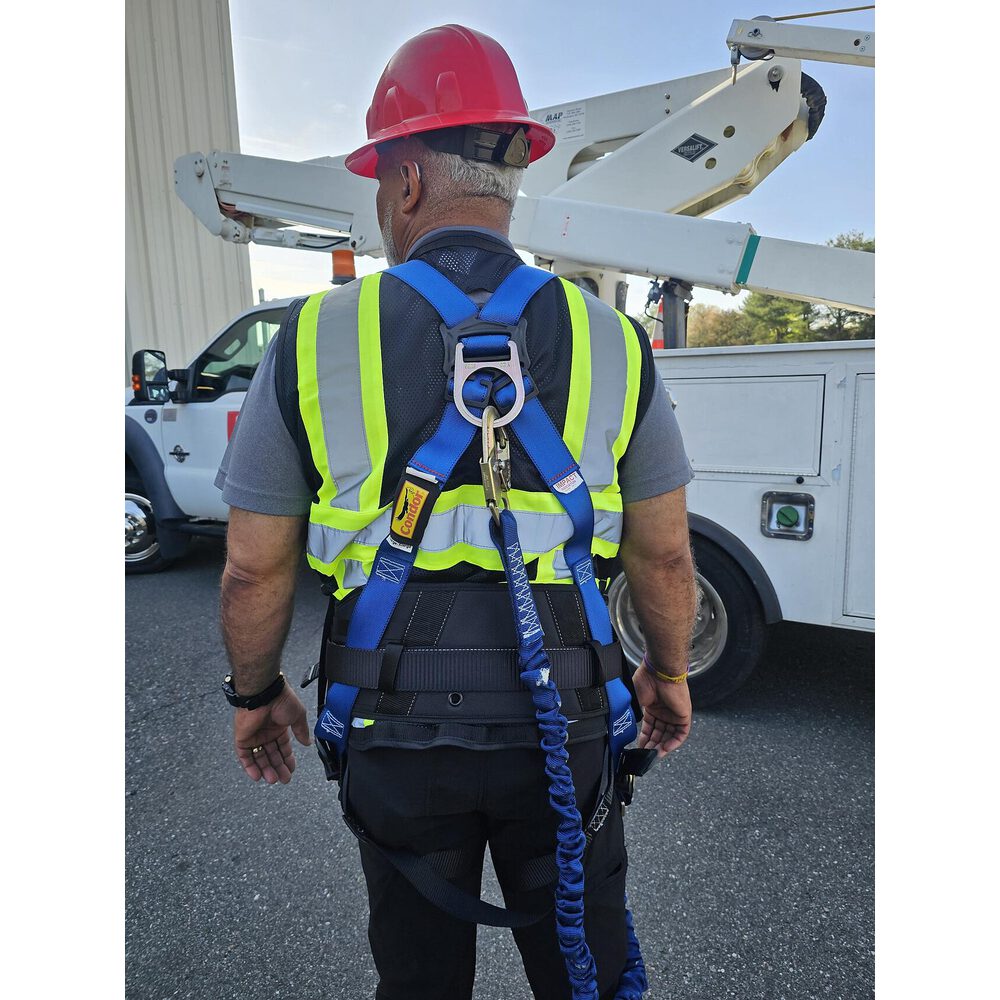
Full body safety harness with dorsal D-ring, adjustable shoulder, chest and leg straps and a shock-absorbing lanyard option, for work at height on buildings, towers and scaffolds.
| Option | Price | Availability | SKU |
|---|---|---|---|
| Harness only | ৳1,500 | In stock | OVY-PB-HARNESS-FB-HARNESS-ONLY |
| Harness with single-hook shock-absorbing lanyard | ৳1,950 | In stock | OVY-PB-HARNESS-FB-HARNESS-WITH-SINGLE-HOOK-SHOCK-ABSORBING-LANYARD |
| Harness with double-hook shock-absorbing lanyard | ৳2,600 | In stock | OVY-PB-HARNESS-FB-HARNESS-WITH-DOUBLE-HOOK-SHOCK-ABSORBING-LANYARD |
Delivery across Bangladesh. Cash on delivery available.
Delivery:
- Inside Dhaka: ৳60, about 2 days
- Outside Dhaka: ৳120, about 5 days
Payment methods: Cash on delivery, bKash, Credit / debit card, Cards, mobile banking and internet banking (SSLCommerz)
Specifications
- Product code
- OVY-PB-HARNESS-FB
- Type
- Fall arrest harness
- Type
- Full body fall arrest harness
- Colour
- Blue and black webbing (as pictured)
- Webbing
- Polyester, approximately 45 mm wide
- Attachment point
- Dorsal (back) steel D-ring for fall arrest
- Adjustment
- Adjustable shoulder, chest and leg straps with steel buckles
- Waist
- Padded waist belt
- Lanyard options
- Single-hook or double-hook lanyard with energy absorber (see variants)
- Lanyard length
- Approximately 1.8 m
- Size
- Universal, adjustable
- Users
- One person; see label for maximum user weight
- Material
- Polyester webbing
- Application
- Work at height, Industrial, Construction
- Model
- Harness only, With double-hook lanyard, With single-hook lanyard
Description
A full body safety harness is a set of webbing straps worn around the shoulders, chest and thighs that holds a worker upright and spreads the force of a fall across the strongest parts of the body. Connected by a shock-absorbing lanyard to a secure anchor, it stops a fall before the worker hits the ground. It has replaced the old waist-only safety belt for fall arrest, because a belt concentrates the whole shock on the abdomen and spine. The photograph shows a blue and black harness with a padded waist belt, worn over a reflective vest, with the lanyard clipped to the D-ring between the shoulder blades.
What makes up a fall arrest system?
A harness alone does nothing. Three parts must work together — often remembered as A, B, C:
| Part | What it is | What to check |
|---|---|---|
| Anchor | Structural point or lifeline the lanyard clips to | Strong enough for fall arrest, at or above shoulder height where possible |
| Body support | The full body harness | Correct size, snug fit, dorsal D-ring between the shoulder blades |
| Connector | Lanyard with energy absorber, or self-retracting lifeline | Hooks fully closed and locked, absorber intact |
Single or double lanyard?
- Single-hook lanyard — for work at one fixed position.
- Double-hook (twin-leg) lanyard — for climbing or moving along scaffolds, towers and steel: you clip the second hook on before releasing the first, so you are attached all the time.
Large scaffold hooks open wide enough to clip on to scaffold tubes and steel angles.
How do you put on a harness?
- Hold the harness by the back D-ring and shake it so the straps hang free; check for twists.
- Put the shoulder straps on like a jacket.
- Bring each leg strap between the legs and buckle it — snug enough that a flat hand, not a fist, fits between strap and thigh.
- Fasten the chest strap across the middle of the chest.
- Adjust so the D-ring sits between the shoulder blades, and tuck away loose strap ends.
How much clearance do you need below?
A lanyard with an energy absorber needs space to work. Adding the lanyard length, the stretch of the absorber, the height of the worker and a safety margin, you typically need about 6 metres of clear height below the anchor. At lower heights use a shorter restraint lanyard that stops you reaching the edge, or a self-retracting lifeline.
What to look for when buying
Fall-protection equipment is marked with its standard — commonly EN 361 for harnesses, EN 355 for energy absorbers, EN 354 for lanyards and EN 362 for connectors, or ANSI Z359. Check the label for the standard, the manufacturing date and the maximum user weight.
Inspection and service life
Inspect before every use: look for cuts, burns, frayed or pulled stitching, chemical stains, stiff or discoloured webbing, and bent, cracked or rusty metal parts. Withdraw the harness and lanyard from service after they have arrested a fall, even if they look undamaged.
Applications
- High-rise building construction and facade work
- Scaffolding erection and dismantling
- Telecom towers and electrical transmission towers
- Steel structure erection and roofing
- Billboard, signboard and glass-cleaning work
- Shipyards, tanks, silos and industrial maintenance at height
Recommended usage
Use only as part of a complete fall arrest system with a suitable anchor and a lanyard with energy absorber or a self-retracting lifeline. Adjust all straps for a snug fit with the D-ring between the shoulder blades, anchor at or above shoulder height where possible, and confirm there is enough clear height below.
Safety instructions
Users must be trained, and a rescue plan must be in place before work starts — a person left hanging in a harness needs to be rescued within minutes. Inspect before every use and never use equipment that is cut, burnt, chemically damaged or has arrested a fall. Never clip to pipes, handrails or anything not confirmed strong enough. Do not tie knots in a lanyard or join two lanyards together. One person per harness and lanyard.
Frequently asked questions
At what height is a safety harness required?
A safety harness is generally required wherever a person could fall about 2 metres or more and there is no guardrail, platform or other collective protection. Many contractors and clients apply a slightly lower limit of 1.8 metres (6 feet) and require fall protection on every scaffold, roof edge and open floor edge.
What is the difference between a safety belt and a full body harness?
A safety belt goes only round the waist, while a full body harness supports the shoulders, chest and thighs. In a fall a belt puts the whole shock on the abdomen and spine and can let the wearer slip out, so belts are now used only for work positioning or restraint, and a full body harness is used for fall arrest.
When should I use a double lanyard?
Use a double-hook lanyard whenever you have to move or climb while exposed to a fall, such as on scaffolds, towers, ladders and steel beams. You attach the second hook to the next anchor before releasing the first, so you are never unattached.
How long does a safety harness last?
There is no single fixed life; it depends on use, storage and the manufacturer's instructions. Many makers give a maximum of around five to ten years from the date of manufacture for webbing products, but a harness must be withdrawn immediately if it fails inspection or has arrested a fall.
Where should the lanyard be anchored?
Anchor the lanyard to a structural point confirmed to be strong enough for fall arrest, at or above shoulder height and as directly overhead as possible. Anchoring at foot level greatly increases the fall distance and the shock, and anchoring off to one side causes a dangerous swing.